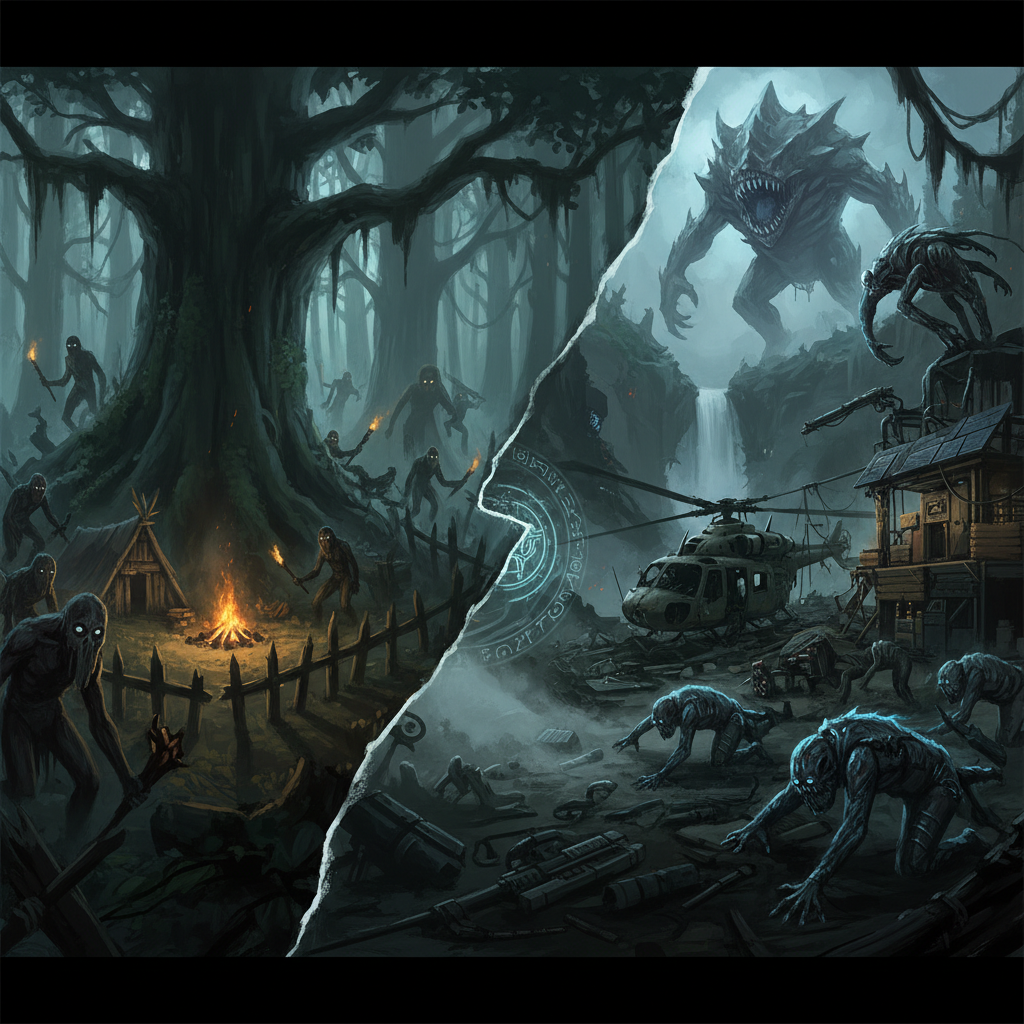
Core Gameplay and Setting
While sharing a foundational survival horror experience, Sons of the Forest (2023) introduces several significant changes compared to The Forest (2014). One of the most immediate distinctions is the setting. Sons of the Forest places players on a seemingly deserted island, a departure from the deep, inescapable woods of the original. This new island is reportedly four times larger than the map in The Forest. Although still in Early Access, the new island is designed to feature more points of interest and diverse biomes, offering a broader exploration experience than the previous game’s more uniform forest environment.
The core loop of gathering resources, constructing bases, and fending off hostile mutants remains, but the sequel aims for a more in-depth approach to these mechanics. Both games spent considerable time in Early Access, with The Forest eventually releasing in 2018 after four years, and Sons of the Forest only recently beginning its Early Access phase.
Technical Advancements
Significant upgrades have been made to the underlying technology in Sons of the Forest. Graphically, the sequel presents an improvement over its predecessor, as expected given the nearly ten-year gap since The Forest’s initial Early Access release. While the visual enhancements, including better models and lighting, are noticeable, the developers acknowledge that the difference might not be as substantial as some might anticipate. Despite this, there’s clear progress in the visual aspect.
A major innovation is the new AI system, which developers refer to as V.A.I.L. This system allows both opponents and friendly NPCs to react with greater accuracy to player actions. The AI in Sons of the Forest is designed to be much more reactive, with enemies capable of organizing smarter attacks and displaying emotions that influence their decisions in real-time. This is a considerable leap from the AI utilized in the previous game, aiming for more complex behaviors from both enemies and NPCs. New enemy types, including various cannibals and upgraded mutants, are also featured, with some cannibals unique to specific environments like caves, and masked cannibals showing brutality towards both players and other cannibals. The game also includes a tri-legged mutant that is neither hostile nor friendly but can be influenced.
Survival Mechanics and Features
Several survival mechanics have been refined or introduced in Sons of the Forest. The inventory system has received a significant overhaul, now featuring a more polished graphical interface and smoother crafting animations. While the crafting system itself remains quite similar to The Forest, the new game doesn’t offer extensive tutorials for it. A notable change is that upon death, players are respawned with all their inventory items, a departure from the original’s mechanics.
One of the most impactful additions is the dynamic weather system with changing seasons. This feature was absent in The Forest. In Sons of the Forest, shifting weather conditions and seasons will significantly influence survival, particularly concerning food cultivation, necessitating new tactical approaches. For instance, snowy winters could make hunting for food more challenging, requiring players to stockpile resources during more fertile seasons.
The sanity meter, a recognizable trademark system from The Forest that represented the player character’s ability to cope with the horrors, has been removed in Sons of the Forest. In the original, this system was not fully realized, and its impact on gameplay was limited. While it’s currently absent, its potential return in a revised form is not ruled out as the game is still in Early Access.
Building mechanics have also seen a considerable upgrade. Sons of the Forest moves away from the “ghosted outline” approach of the original, offering a more organic and creative building process. Players have greater control over intricate details, such as carving out windows or sharpening pointed fences. Furthermore, a new digging mechanic has been confirmed, with shovels playing a role, allowing players to interact with diggable ground, a feature not present in The Forest.
Multiplayer and AI Companions
Sons of the Forest launched with co-op capabilities, a feature that was added later to The Forest. At launch, the sequel supports up to four-player co-operative multiplayer. There is no official confirmation yet on whether it will eventually support eight-player co-op, like its predecessor did, which was a popular feature.
For solo players, Sons of the Forest introduces an AI companion named Kelvin. Kelvin is described as an elite soldier who has suffered severe head trauma, rendering him unable to speak. He can assist players with tasks such as chopping down trees and gathering logs, taking commands to perform repetitive busywork, thus aiding in base construction and resource management.
FAQ
Is the map larger in Sons of the Forest than in The Forest? Yes, the map in Sons of the Forest is reportedly four times larger than the map in The Forest.
Does Sons of the Forest have a sanity meter like the first game? No, the sanity meter present in The Forest is not included in Sons of the Forest.
Can I play Sons of the Forest with an AI companion? Yes, Sons of the Forest features an AI companion named Kelvin who can assist with tasks like gathering resources and building.
Are there dynamic seasons and weather in Sons of the Forest? Yes, Sons of the Forest includes a dynamic weather system with changing seasons, which was not a feature in The Forest.
How many players can co-op in Sons of the Forest at launch? Sons of the Forest supports up to four-player co-op at launch.